The Promise You Never Read Until the Floor Is Wet
Somewhere in a drawer, or buried in an email from three years ago, there’s an invoice with a little line at the bottom. 100% satisfaction guarantee. Maybe one-year warranty on repairs.
You saw it. You felt good about it. You never read past it.
And now you’re staring at a dripping shutoff valve wondering something that feels almost silly to say out loud: does any of that apply to a plumber? Or was it only ever about the furnace?
Look, that’s a fair question, and almost nobody can answer it about their own home. Not because homeowners are careless — because checking properly means digging out contracts, comparing manufacturer paperwork against labor terms, and asking someone uncomfortable questions. Who has an afternoon for that?
So let’s do the short version. Ten minutes, four questions, and one table showing what plumbing coverage really looks like.

Why the Full Audit Never Happens
Here’s the honest truth about home paperwork.
A complete coverage review means finding every agreement you’ve signed, reading the exclusions, matching them to your equipment, and calling two or three companies about the vague parts. Half a day, minimum. The reward is a feeling. Nobody schedules that.
But here’s what matters. You don’t need a complete review. You need to know which promises are real, which ones quietly stop at the edge of a different trade, and how to get somebody to say it in plain English before the work starts.
That’s the whole job. And it happens over the phone.
The Word “Warranty” Is Doing Two Jobs at Once
This is where most confusion comes from, and once you see it you can’t unsee it.
A new water heater carries a manufacturer’s warranty — six years on the tank, say. That’s a promise from the factory about the part. If the tank fails in year four, you get a replacement tank. Nobody pays to drain the old one, haul it out, and hook up the new one.
The labor is a separate promise entirely, and it comes from the company that did the work. That’s the one nobody thinks to ask about. It’s also the one that costs you money.
What Plumbing Coverage Really Looks Like
Read this table with your own home in mind. The right-hand column is the part to actually use.
| What Broke | Who Usually Backs It | Typical Coverage | The Question That Settles It |
|---|---|---|---|
| Water heater tank | Manufacturer | 6–12 years on the tank only | “Does that include the labor to swap it, or just the part?” |
| Faucets, toilets, disposals | Manufacturer | 1 year to lifetime, part only | “If you install a fixture I bought, do you still warranty the labor?” |
| Labor on a repair | The company that did it | 30 days to 1 year, varies wildly | “How long is your labor warranty, and is it on the invoice?” |
| Drain clearing | The company that did it | Often 30–90 days, sometimes none | “If it backs up again next month, who pays for the trip?” |
| Repipe or supply line work | The company that did it | Commonly 1–5 years on workmanship | “What voids it, and does it transfer if I sell?” |
| Sewer repair or lining | Mixed — material and workmanship | Material warranties can run decades | “Is the liner warranty separate from your labor warranty?” |
| Satisfaction guarantee | The company | Usually the whole company, all trades | “Does that guarantee cover plumbing calls too?” |
| After-hours callback | The company | Rarely spelled out anywhere | “If the repair fails at 10 p.m., is the emergency fee waived?” |
Notice something? Six of those eight rows depend entirely on the company, not the brand of the part. The manufacturer sticker on the box is the smallest piece of your protection.
The Fine Print That Actually Bites
A few exclusions show up again and again, and they’re worth knowing before you’re annoyed about them.

Parts you supply yourself. Found a great deal on a faucet online? Many companies will install it and warranty their labor — plenty won’t warranty anything at all. Ask first, not after.
Recommendations you declined. If a technician wrote “pressure at 95 psi, recommend PRV” and you passed, a later fixture failure may sit outside the warranty. That note protects them — and honestly, it protects you too, as a record of what your house was doing that day.
The damage, versus the repair. A workmanship warranty usually covers redoing the work. Water damage to your flooring is a different conversation, and that’s where homeowner’s insurance comes in. Ask how a company handles it.
Drains, because clogs come back. A cleared line that clogs again isn’t always a failed repair — sometimes it’s roots in a cast iron lateral that needs a camera and a real fix. Good companies say that upfront instead of selling you the same clearing four times.
The Ten-Minute Coverage Check
Ready? Grab your phone. This is faster than you think.
Minutes one through three: find one invoice. Any recent service invoice, from any home company. Look at the bottom for the words guarantee, warranty, or workmanship, then photograph it.
Minutes four through six: search the agreement. On a maintenance plan? Open the document and use the find function for “plumbing,” “water heater,” and “warranty.” Most plans are built around heating and cooling and simply stop there. Absence of the word is your answer.
Minutes seven through ten: make one call. Ask whichever questions from that table’s right column apply to you. Then ask for the answers to be written on your next invoice.
That last part is the whole trick. A verbal promise is worth exactly what it’s written on.
What This Check Can’t Do
Be clear-eyed. This doesn’t work if the company won’t give you specifics, and that vagueness is itself information.
It also can’t tell you whether a contractor is properly licensed for the work. In Virginia, contractors are licensed through the Department of Professional and Occupational Regulation, and you can look up a license number in a couple of minutes. There’s also the Virginia Contractor Transaction Recovery Fund, which may reimburse certain losses caused by a licensed contractor when a court judgment can’t be collected — a protection that generally doesn’t exist at all if you hired someone unlicensed. Ask for the number. Any company that hesitates has told you something.
The Coverage Most of Our Customers Already Have and Don’t Know About
Now the part that stings a little on our end.
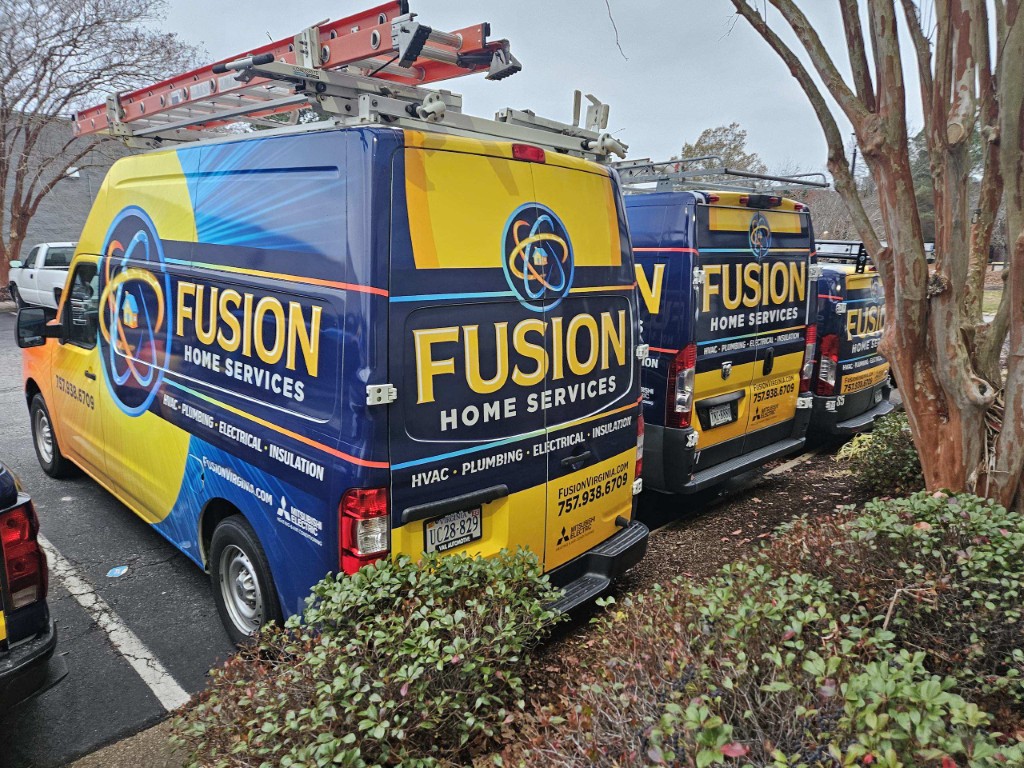
If you’ve had Fusion Home Services in your home for heating, cooling, or insulation, you already know the terms — free estimates, a 100% satisfaction guarantee, and a one-year warranty on repairs. What plenty of longtime customers don’t realize is that those are company terms, not comfort-system terms. They aren’t a heating department policy. The same guarantee stands behind a leak repair, a toilet reset, or a sump pump.
We’ve had customers call a stranger for a water heater the week before we were already scheduled to be at their house. That one is on us for not saying it loudly enough.
So here it is plainly. Fusion Home Services handles plumbing right alongside heating, cooling, and insulation — leak detection and repair, water and supply line work, drain and sewer clearing, toilets, faucets, tubs and showers, disposals, water pressure problems, sump pumps, filtration, and every kind of water heater there is. Same number that’s already in your phone.
Why does one company across trades matter here specifically? Because warranty arguments usually come down to history. When a fixture fails, the fight is over what caused it — pressure, an old supply line, something a previous contractor did in 2016. A company that’s been in your crawl space twice a year already has that answer written down. A plumber meeting your house for the first time is guessing, on your dime, on your worst day.
That’s the difference between having a guarantee and being able to use one.
When the Answer Comes With a Big Number
Sometimes the coverage check ends with bad news. The tank is out of warranty. The supply lines are gray polybutylene, and no warranty in the world covers a material that aged out.
Two questions before you spiral.
Ask whether financing applies to plumbing work and not only comfort systems. Home service companies advertise financing next to furnaces constantly, and homeowners quietly assume a repipe or a sewer job doesn’t qualify. Say it out loud and make somebody answer.
Then ask what the diagnostic fee is in dollars and whether it comes off the repair. A company that answers that in one sentence will answer your warranty questions the same way. It’s worth checking current specials before you book, too.
And here’s the exception worth naming: work done on your schedule almost always carries better terms than work done in an emergency. Nobody negotiates warranty language at 11 p.m. with a wet-vac running.
Frequently Asked Questions
Does a satisfaction guarantee usually cover plumbing work?
It depends on how the company wrote it. A guarantee attached to a specific department covers that department; a company-wide guarantee covers every trade that company performs, plumbing included. Ask which kind you have, and get the answer printed on your invoice rather than repeated over the phone. If a company can’t tell you in one sentence which of the two it is, treat that as the answer.
What’s the difference between a parts warranty and a labor warranty?
The parts warranty comes from whoever manufactured the equipment and typically replaces a failed component only. The labor warranty comes from the contractor who installed it and covers the cost of the work — diagnosis, removal, installation, and the trip. A water heater with a six-year tank warranty and a 30-day labor warranty can still cost you several hundred dollars in year two, which surprises people every single time.
How long should a plumbing repair be warrantied?
One year on workmanship is a reasonable benchmark for most repairs, and repipes or larger installations often carry longer terms. Drain clearing is the outlier and usually runs shorter, because a line that clogs again may have a structural problem rather than a failed repair. If a company offers only 30 days on general repair labor, ask why.
Does a plumbing warranty transfer when I sell my house?
Sometimes, and it’s worth real money at closing when it does. Workmanship warranties on repipes, sewer lining, and water heaters are the likeliest to transfer, and the paperwork answers a buyer’s inspection question before it becomes a negotiation. Ask about transferability at the time of the work — adding it later is rarely an option.
Get the Promise in Writing
You don’t need a comprehensive audit of your home coverage. You’re never going to run one, and that’s fine.
What you need is ten minutes, one invoice, and four questions asked out loud before anyone touches a pipe. Who backs the part. Who backs the labor. How long. What voids it. That’s a real audit, and it fits in a coffee break.
Fusion Home Services works across Virginia Beach, Chesapeake, Norfolk, Portsmouth, Suffolk, Newport News, and Hampton, running plumbing, heating, cooling, and insulation under one roof — with the same guarantee behind all of it. If we’ve already been in your crawl space, we’d much rather stand behind the fix than meet your house on its worst day.
Pull up one invoice tonight and read the bottom line. Then ask us the four questions at fusionvirginia.com — and tell us what your paperwork actually says.