Count the Emails. That’s the Whole Audit.
Open your email right now and search your inbox for “tune-up.”
Go ahead. We’ll wait.
You probably found a dozen. Spring reminder, fall reminder, filter reminder, a confirmation from last April. Years of steady, friendly nudges about your heating and cooling system.
Now search the same inbox for “plumbing.”
Nothing. Not one message. And your house has been full of pipes the entire time.
Here’s the thing — that empty search result is more useful than it looks. It’s not a small marketing oversight. It’s a map of where nobody has been looking, and in about ten minutes at your kitchen table you can turn it into the closest thing to a home audit that a busy person will ever actually finish. No flashlight. No crawl space. No half day off work.

Why Real Auditors Never Check Everything
Let’s borrow something from the people who audit for a living.
A compliance auditor walks into a company with a limited budget and a deadline. They can’t examine every transaction, so they don’t try. Instead they look for the areas with the thinnest paper trail, because that’s where problems survive the longest — not necessarily where things are worst, but where nobody has been checking.
It’s called risk-based sampling. And it’s exactly the right tool for a homeowner with a job, kids, and one free evening.
You’re never going to book the comprehensive whole-home inspection. Be honest with yourself about that. It takes a half day, costs real money, and the best possible outcome is a professional telling you your house is probably fine. That’s a hard yes when the car is making a noise and the dishwasher is on its last legs.
So stop trying to inspect the house. Audit the records instead.
The System With No File Is the System at Risk
Every major system in your home has a history. Some of them have a written one.
Your furnace and air conditioner have a file. Invoices, dates, a technician’s name, notes about a capacitor somebody replaced in 2023. Trained eyes on that equipment twice a year, with paper to prove it.
Your water heater, supply lines, sewer lateral, sump pump, shutoff valves? For most homes, nothing. No dates. No notes. No baseline. Nobody has ever written down what normal looks like.
That’s the finding. Not “your pipes are bad.” Just — nobody has ever checked, and that’s the room worth walking into first.
The Ten-Minute Kitchen Table Audit
Here’s how to run it. Coffee optional, but recommended.
Minutes one through four: search your inbox. Search for the name of any company that has serviced your home, plus the words “invoice,” “receipt,” “tune-up,” and “service.” Skim the dates. You’re not reading them closely — you’re just noting which systems show up and which never do.
Minutes five through seven: read your maintenance agreement. Find the actual document, not your memory of it. Use your browser’s find function and search for “water heater,” “flush,” “plumbing,” and “drain.” Most agreements are written around heating and cooling equipment and stop there, even though the technician walks right past the water heater to reach the furnace. If those words aren’t in your agreement, that equipment is not covered, no matter what “home maintenance plan” sounds like.
Minutes eight through ten: fill in the blanks below. One line per system. A date if you have one, a blank if you don’t.
| System in Your Home | Last Documented Service | What a Blank Line Means | What It Costs to Find Out the Hard Way |
|---|---|---|---|
| Furnace / air handler | Usually well documented | Nothing — this one’s covered | Covered by your plan |
| Air conditioner | Usually well documented | Nothing — this one’s covered | Covered by your plan |
| Water heater tank | Almost always blank | No flush, no anode rod check, no baseline | $1,800–$4,500 with water damage |
| Main shutoff valve | Almost always blank | Nobody has turned it since installation day | You can’t stop the flood you’re standing in |
| Supply lines in the crawl space | Almost always blank | Corrosion or gray polybutylene nobody has flagged | $5,000–$20,000 to repipe |
| Sewer lateral | Almost always blank | No camera has ever been down it | $6,000–$20,000, plus your yard |
| Sump pump and discharge | Almost always blank | Untested until the storm that needs it | Crawl space flooding in a nor’easter |
| Water pressure | Almost always blank | Over 80 psi quietly beating up every fixture | Repeat “mystery” leaks in unrelated rooms |
Look at the shape of that column. Two rows with a history. Six without.


What the Blank Rows Are Actually Telling You
Now sort the blanks by one question: which of these fails wet?
That’s your priority order, and it isn’t close. A furnace that quits makes you cold — frustrating, sometimes expensive, occasionally urgent. A supply line that lets go makes you wet, and it keeps making you wet until somebody finds a valve that hasn’t turned in twelve years.
If your home went up between 1978 and 1995, move the supply line row straight to the top. More than a quarter of Virginia Beach homes were built in the 1980s alone, and that era ran on polybutylene — dull gray flexible pipe with crimped bands at the fittings, installed in as many as ten million American homes and responsible for roughly a billion dollars in payouts. Some insurers still flag it at renewal. A buyer’s inspector absolutely will.
If you’re in an older Norfolk or Portsmouth neighborhood, move the sewer lateral row up instead. Cast iron and clay don’t announce themselves until roots have already found them.
Two rows. That’s your whole to-do list. Everything else can wait.
Why Your Mailbox Had That Blind Spot
Time for the uncomfortable part, and it’s ours, not yours.
The reason your inbox has twelve heating reminders and zero plumbing ones isn’t that your pipes are fine. It’s that home service companies built their reminder systems around the trades they started in, and then never widened them. The mail goes out on the same rails it’s used for years.
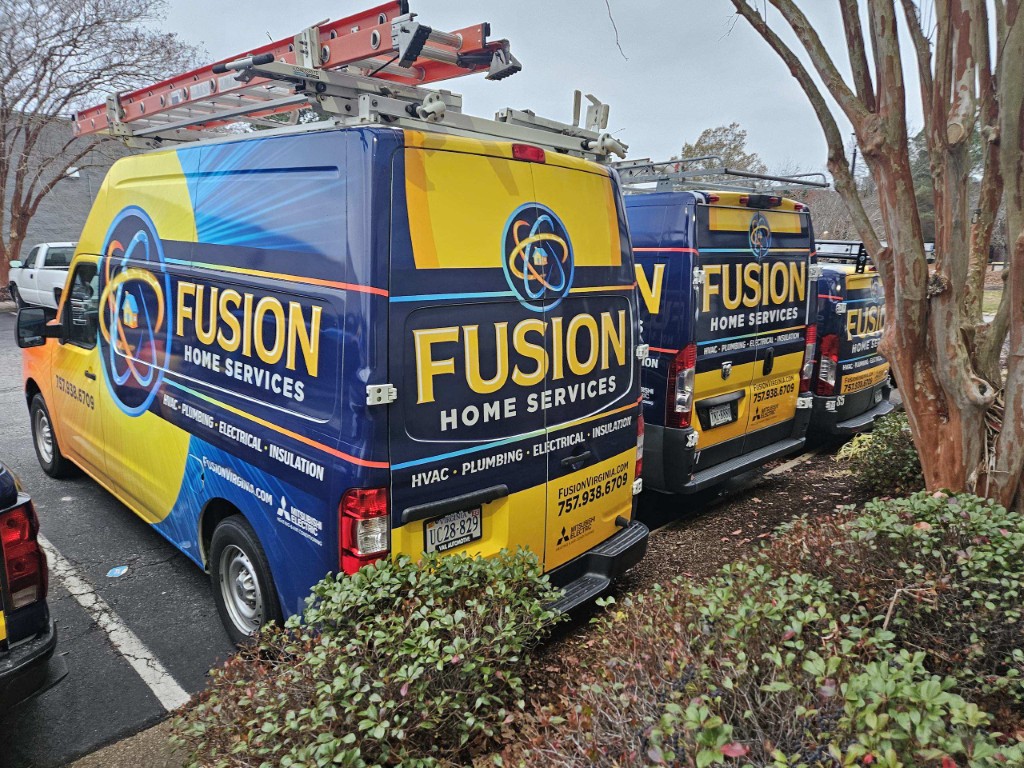
Fusion Home Services has been guilty of exactly that. For years the sign said heating, cooling, and insulation, and the mail matched. Meanwhile our own longtime customers — people whose crawl spaces we’ve been in twice a year — have called a stranger for a leaking water heater the week before we were already scheduled to be at their house.
That one stings, and it’s on us for never saying it out loud.
So here it is plainly. Fusion Home Services handles plumbing right alongside heating, cooling, and insulation: leak detection and repair, water and supply line work, drain and sewer clearing and repair, toilets, faucets, tubs and showers, disposals, water pressure problems, sump pumps, filtration, and every kind of water heater there is. Same phone number that’s already in your contacts.
Why does one company across trades matter beyond convenience? Because a plumber meeting your house for the first time is meeting it on its worst day — water on the floor, everybody’s blood pressure up, a stopwatch running. A crew that’s been under that house for years already knows how the lines run and what the crawl space looked like last October. Under pressure, that history is worth real money.
Which is really the same point this whole article is making. The file is the asset.
Turning Your Blank Rows Into a Real File
You’ve got two priority rows. Here’s how to close them without booking anything comprehensive.
Add the plumbing walk-through to a visit you’re already paying for. When you schedule your next tune-up, say one sentence: while you’re down there, look at the water heater and the supply lines. The technician is already in the crawl space with a light and dirty knees. The access is open. That’s the cheapest inspection available to you, and it costs you a sentence.
Then ask for it in writing. A date and a few notes turns a blank row into a baseline, and next spring you’ll have something to compare against. That’s the entire point of an audit trail.
Be clear-eyed about limits, though. This doesn’t work for anything hidden. Lines inside walls or under a slab need leak detection equipment, and a sewer lateral needs a camera — no visual walk-through sees through drywall or dirt, and anyone who says otherwise is selling something.
When the Audit Finds Something Expensive
Say the tech confirms gray polybutylene. Now there’s a real number attached, and it isn’t small.
Two questions before you panic. First, ask whether financing covers plumbing work and not just comfort systems — companies advertise financing next to furnaces constantly, and homeowners quietly assume a repipe doesn’t qualify. Say it out loud and make somebody answer.
Second, ask what the diagnostic fee is in dollars and whether it comes off the repair. A company that answers that in one sentence will answer your other questions the same way. Glance at current specials before you book, too.
And here’s the exception worth naming: if you’re already opening walls for a kitchen or bath remodel, repiping that section costs a fraction of what it does standalone. Timing moves the price more than haggling ever will.
Frequently Asked Questions
How do I know what my maintenance plan actually covers?
Find the agreement itself and search the text for “water heater,” “flush,” “drain,” and “plumbing.” Most plans are written around heating and cooling equipment — burners, coils, blowers, refrigerant — and stop there. If those words don’t appear, that equipment is uncovered even though the technician passes it on the way to the furnace. In most cases you can add a plumbing walk-through to a visit you’re already paying for just by asking when you schedule.
Why does service documentation matter for plumbing specifically?
Because plumbing problems announce themselves slowly and hide well. A mineral trail, a slightly darker joist, a spot of corrosion — none of that means anything on its own. It only means something compared to what that same spot looked like a year ago. Heating and cooling equipment gets that comparison automatically through routine service. Plumbing rarely does, which is why a written baseline is worth more here than almost anywhere else in the house.
How often should plumbing get looked at?
A visual check twice a year, ideally lined up with spring and fall HVAC service so somebody trained is already in the crawl space. Add a professional sewer camera inspection every three to five years if your home predates 1970 or sits on a lot with mature trees, since roots find clay and cast iron laterals long before you notice a slow drain.
I rent out a property. Does this audit still apply?
Even more so, and the paper trail matters twice as much. You’re not in the building often enough to notice a slow change, and tenants report problems at the emergency stage rather than the early one. Run the same records audit per property, and ask your service company for written notes on each visit so you’re comparing documents instead of memories.
Your Empty Search Result Was the Finding
You went looking for a plumbing audit and found an empty inbox. That was the audit.
You don’t need a half-day inspection you’ll never schedule. You need ten minutes with your records, two rows flagged as blank, and one sentence at your next tune-up. That’s a risk-based audit, and it’s the kind that actually gets finished.
Fusion Home Services works across Virginia Beach, Chesapeake, Norfolk, Portsmouth, Suffolk, Newport News, and Hampton, running plumbing, heating, cooling, and insulation under one roof. If we’ve already been in your crawl space, we’d much rather be the ones who spot the problem early than the ones you call after the floor is wet.
Run the search tonight. Then book the walk-through at fusionvirginia.com and tell us which rows came up blank — we’ll start there.